


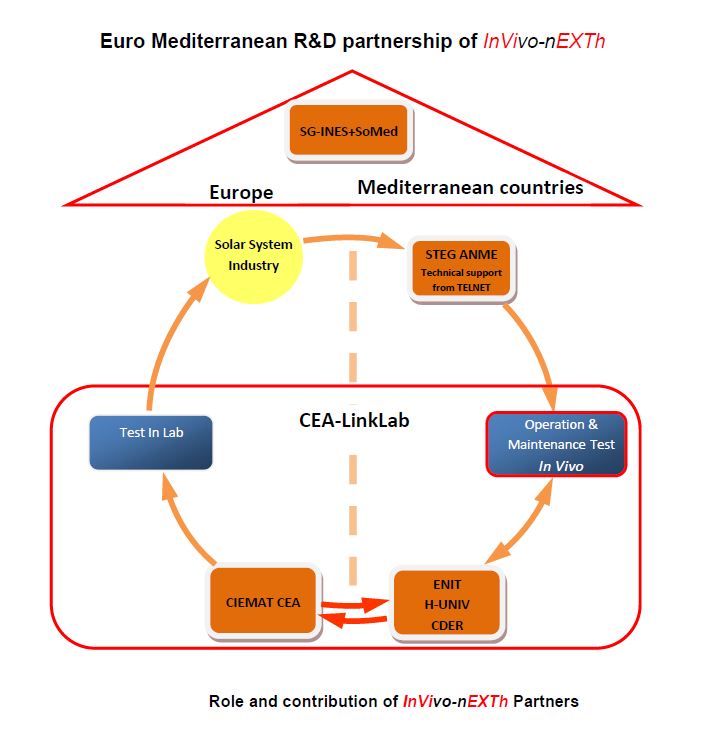
The project is subdivided into 6 work packages:
WP1 : Project Management
The overall objective of WP1 is to ensure that the overall objectives of the project are achieved in accordance with the agreement, on time and on budget.
WP2 : Collecte des données
The objective of this work package is to collect a set of O & M data on photovoltaic installations in the Mediterranean regions in terms of environmental context, technical description, human behavior and monitoring of solar technologies.
WP3 : Effectiveness factors of OM in difficult environments of the Mediterranean
The objective of this work package is to analyze the first database and the surveys carried out within the framework of the project in order to:
-
Evaluate the effectiveness of solar technologies in the Mediterranean regions.
-
Extract important factors from the effectiveness of solar technologies in a severe Mediterranean environment
WP4 : Update of the OM protocol on a sample of photovoltaic solar systems
-
Choice of preventive / curative technologies, sites and protocols
-
Proposals by operators to update the OM of the Mediterranean solar systems in order to reduce the impact of the factors of efficiency loss.
-
Forecast of gain and Estimation of costs
WP5 : Evaluation of the System Sample Update
The objective of this work package is:
-
Collection of new solar plant production records.
-
The impartial evaluation of the gain efficiency and operators feedback.
WP6 : Communication and dissemination
A drafting team composed of one representative per region and led by SG-INES will be responsible for publishing the actions for the website, newsletters, brochures and external communication.


